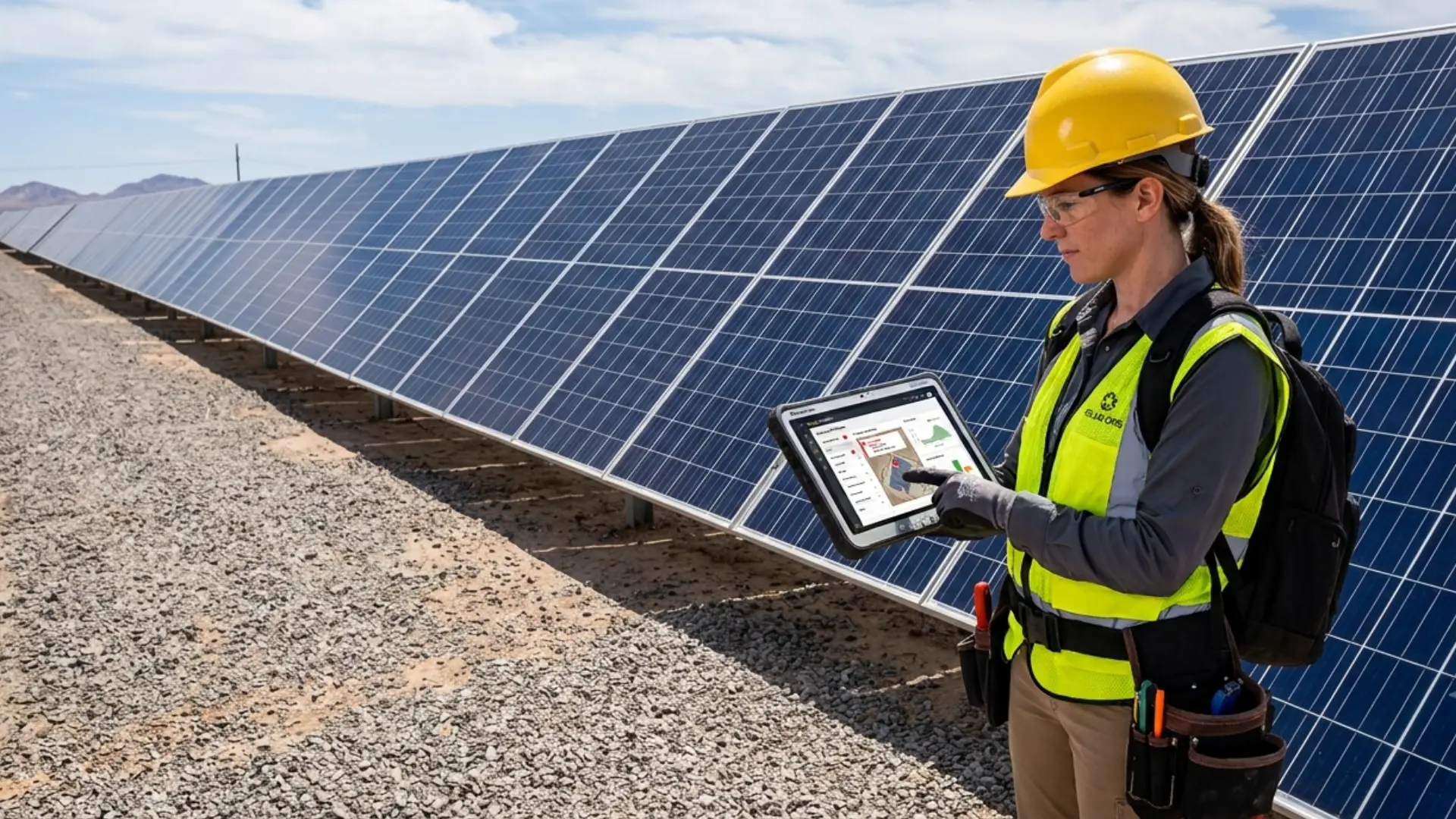
When a private equity firm acquires your solar CMMS vendor, five things happen: prices increase, the product roadmap changes, data portability becomes difficult, support deteriorates, and your operational continuity depends on their decisions. Five Hundred eliminates this risk by deploying inside the client's own Microsoft Azure tenant — making the software something the operator owns, not rents from a company that may be sold.
The CMMS Acquisition Wave and Why Solar Operators Should Care
The Computerised Maintenance Management System (CMMS) market has been a target of significant private equity acquisition activity over the past five years. Software platforms serving industrial and operational markets — particularly those with recurring SaaS revenues and sticky customer relationships — are attractive acquisition targets. Several widely-used CMMS platforms have changed ownership within the last three years.
UpKeep, one of the most widely adopted mobile-first CMMS platforms, was acquired in 2022. Limble CMMS received significant institutional investment. Fiix was acquired by Rockwell Automation. eMaint (part of the Fluke family) has changed structure under Fortive ownership. The pattern is consistent: SaaS CMMS platforms with recurring revenues and large user bases are being consolidated.
For solar O&M operators who have built operational workflows, historical data, and team habits around one of these platforms, an acquisition event triggers five concrete risks — each of which has materialised for customers in other sectors, and each of which is entirely avoidable with the right architectural choice.
The Five Risks When Your CMMS Vendor Is Acquired
Risk 1: Price Increases After Lock-In
Private equity acquirers of SaaS businesses routinely implement price increases as part of their post-acquisition value capture strategy. The calculus is straightforward: operators who have spent 12–18 months embedding a CMMS into their workflows, training teams, and building historical data cannot easily switch — making them price-inelastic customers.
Contract renewal time is the moment of maximum vulnerability. Customers who accepted Year 1 pricing at €150/user/month frequently find Year 3 or Year 4 renewal offers at €200–250/user/month — a 33–67% increase justified by "product investment" that may or may not benefit the operator's specific use case.
For a solar O&M operator with 15 active CMMS users, a 50% price increase represents an additional €13,500–22,500 annually in software cost with no corresponding improvement in their operational capability. The total over a 5-year contract horizon at 10% annual increases becomes a compounding liability.
Risk 2: Product Roadmap Redirection Away from Solar
Solar O&M is a specialised operational domain. IEC 62446 documentation requirements, SCADA integration patterns, inverter-specific fault codes, and PV-specific preventive maintenance schedules are not general industrial maintenance requirements. Generic CMMS platforms that have developed solar-adjacent features typically did so in response to customer requests, not as a core product strategy.
Post-acquisition, product roadmaps are typically redirected toward the new owner's priority markets. A CMMS acquired by an industrial conglomerate may invest development resources in manufacturing, facilities management, or oil and gas — leaving solar-specific features unmaintained. Features that worked in Version 3.x may not be present in Version 5.x after the product is restructured around a new acquiring company's integration priorities.
For solar operators, the risk is not immediate product failure — it is gradual erosion of the solar-specific functionality that justified the platform choice in the first place.
Risk 3: Data Portability Becomes a Negotiation
Operational data accumulated in a solar CMMS over 3–5 years — work order history, fault records, maintenance costs, performance logs, technician records — is operationally irreplaceable. Historical data is required for IEC 62446 documentation compliance, insurance assessments, and due diligence during asset sales or portfolio refinancing.
SaaS CMMS vendors control data export formats and APIs. Post-acquisition, API access may be restructured, export features may be paywalled, or data formats may change in ways that break existing integrations. Operators who need to migrate have discovered that extracting complete historical records in a usable format requires negotiation, technical assistance fees, and extended timelines — during which their operational continuity depends on the vendor's cooperation.
This is a risk that does not exist with Five Hundred. All data is stored in Microsoft Dataverse within the client's own Azure tenant. The operator can export, query, migrate, or delete data at any time using standard Microsoft tools, with no dependency on WIZSP's cooperation.
Risk 4: Support Quality Deteriorates
Post-acquisition support deterioration is one of the most consistently reported customer experiences in enterprise software. The customer success teams, technical support staff, and implementation specialists who understood the solar O&M context — and who were the reason the platform worked well — are frequently reorganised, downsized, or replaced in post-acquisition cost rationalisation programs.
For solar operators with complex integrations (SCADA connections, custom Power BI reports, IEC 62446 workflows), support deterioration is not merely inconvenient — it creates operational risk at the moments when the platform must perform reliably.
Risk 5: Platform Sunsetting or Forced Migration
The most severe scenario — platform sunsetting — occurs when an acquiring company decides to consolidate acquired products onto their own platform and phases out the acquired system. This is not hypothetical: multiple enterprise software acquisitions over the past decade have resulted in forced customer migrations within 2–4 years of acquisition, with migration tooling and timelines that did not match customer operational needs.
For a solar O&M operator who has built IEC 62446 documentation workflows, investor reporting templates, and SCADA integrations into a CMMS platform over 4 years, a 12-month forced migration is an operational disruption event — occurring at a time not of their choosing, with costs not in their budget.
Contract Clauses to Demand If You Use a SaaS CMMS
If operational constraints require a SaaS CMMS, these contractual provisions reduce but do not eliminate acquisition risk:
- Change-of-control clause: Grants the customer the right to terminate with a refund of pre-paid amounts if the vendor is acquired by a named category of buyer (private equity, competitor) or within a specified period.
- Price increase cap: Limits annual price increases to a defined percentage (typically CPI or 5%, whichever is lower) for the contract term. Must survive acquisition.
- Data portability guarantee: Commits the vendor to provide complete data export in standard formats (CSV, JSON, open API) within 30 days of customer request at no additional charge. Must include all historical records.
- Feature continuity clause: Requires the vendor to maintain all named features and integrations for the contract term. Any removal triggers a price reduction or early termination right.
- Support SLA with teeth: Specifies response times for critical issues with defined remedies (credits, termination rights) for non-compliance — not just aspirational commitments.
How Five Hundred Eliminates Vendor Acquisition Risk by Architecture
The architectural answer to vendor acquisition risk is ownership. Five Hundred is not a SaaS platform — it is a Microsoft Power Apps, Dataverse, Power Automate, Power BI, and Teams solution deployed inside the client's own Azure tenant. After go-live, WIZSP has no ongoing operational role in the client's system.
This means: if WIZSP is acquired, merged, or ceases to exist tomorrow, the client's Five Hundred system continues to operate. All data remains in the client's Dataverse. All workflows continue in Power Automate. All dashboards continue in Power BI. The client's IT team can maintain, update, and extend the system using Microsoft's published documentation and any Microsoft partner — not specifically WIZSP.
| Risk | SaaS CMMS | Five Hundred (CAPEX model) |
|---|---|---|
| Price increases post-acquisition | High — renewal pricing at vendor discretion | None — one-time CAPEX, no renewal |
| Roadmap redirection away from solar | High — dependent on acquirer priorities | None — Microsoft 365 platform evolves independently |
| Data portability | Medium — subject to vendor cooperation and fees | None — client owns all data in their own Dataverse |
| Support deterioration | High — post-acquisition reorganisation common | Low — Microsoft community and partner ecosystem available |
| Platform sunsetting | Possible — 2–4 years post-acquisition | None — Microsoft 365 is not at risk of sunsetting |
Frequently Asked Questions
What happens to my solar CMMS data if my vendor is acquired?
If your SaaS CMMS vendor is acquired, your data remains on the vendor's infrastructure — now controlled by the acquiring company. Data export rights depend on your contract terms. Without an explicit data portability clause, extracting historical records in a usable format may require negotiation, technical assistance fees, and extended timelines. With Five Hundred, all data is in your own Microsoft Dataverse — accessible and exportable at any time with no vendor dependency.
Which solar CMMS vendors have been acquired in recent years?
Several widely-used CMMS platforms have changed ownership: UpKeep was acquired in 2022; Fiix was acquired by Rockwell Automation; eMaint operates under Fortive through Fluke. The CMMS market consolidation trend reflects the attractiveness of recurring SaaS revenue businesses to private equity and strategic acquirers. Solar O&M operators using any of these platforms face the acquisition risks described in this article.
What contract clauses protect me from CMMS vendor acquisition risk?
Key protective clauses include: a change-of-control termination right with pre-paid amount refund; price increase caps tied to CPI or a fixed percentage; data portability guarantees in standard formats within 30 days at no charge; feature continuity clauses for named integrations; and support SLAs with defined remedies for non-compliance. These reduce but do not eliminate acquisition risk — they remain subject to acquirer willingness to honour contract terms.
Does Five Hundred continue to work if WIZSP is acquired or ceases to exist?
Yes. Five Hundred is deployed inside the client's own Microsoft Azure tenant. It runs on Microsoft Power Apps, Dataverse, Power Automate, and Power BI — all of which are maintained by Microsoft independently of WIZSP. If WIZSP ceases to exist, the client's system continues to operate. All data remains in client-owned Dataverse. Any Microsoft partner can maintain, extend, or modify the system using standard Microsoft development practices.
Related: Solar CMMS Total Cost of Ownership: CAPEX vs SaaS · Five Hundred vs Maximo, Fiix, UpKeep, and FieldEx · Brighter Green Engineering Case Study