Introduction
The number that kills most solar CMMS evaluations is not the implementation fee — it is the per-user seat count multiplied by thirty-six months. Take a mid-scale European solar operator: fifty technical and administrative users, a leading SaaS CMMS at €45 per user per month. That is €81,000 in software rental in the first three years. By year five, €135,000 spent and nothing owned.
Now consider the platform already running on every laptop in your organisation. Microsoft 365 — the stack that runs your email, your documents, your video calls, and your identity infrastructure — contains every architectural layer a solar operations and maintenance platform requires. Not as a workaround. As a deliberate design decision.
This article makes the case — with technical specificity, not marketing language — that Microsoft 365 is the most logical, most secure, and most cost-effective foundation for solar O&M software available in 2026. It is the case that Five Hundred by WIZSP has built its entire platform on. And it is, structurally, the case nobody else in the solar software market is currently making.
We cover what the dominant SaaS CMMS platforms get wrong for solar, what the Microsoft 365 stack actually provides at each operational layer, why another SaaS silo is the wrong architectural choice for critical energy infrastructure, and how to evaluate whether an M365-native CMMS fits your portfolio.
/fusion_builder_column]
The Solar CMMS Market Has a Platform Problem
The solar O&M software market in 2026 sits at an awkward crossroads. Three categories of platform compete for the same buyer, and none fits cleanly.
Enterprise EAM systems were designed for utilities and heavy industry. They are powerful, expensive, and slow to implement. They require dedicated system administrators and multi-year implementation programmes. Total cost of ownership over five years routinely exceeds €500,000 when implementation, licensing, and support are totalled.
Generic SaaS CMMS platforms were built for facilities management and light industrial maintenance. They are accessible and modern, but they carry no concept of solar-specific asset hierarchies. A Huawei SUN2000 inverter, a Sungrow string inverter, and a legacy Fronius central inverter are all simply ‘assets’ in these platforms — indistinguishable in the data model from an HVAC unit. Performance Ratio tracking, SCADA alarm integration, OEM warranty compliance workflows, and IEC 62446 documentation requirements do not exist as standard fields. Workarounds do not scale across a twenty-site portfolio.
APM and monitoring platforms are fundamentally analytics tools, not CMMS platforms. They monitor performance data with precision. They do not manage work orders, technician dispatch, spare parts inventory, or corrective maintenance workflows. Operators who purchase a monitoring platform expecting CMMS functionality discover the gap during their first major corrective maintenance event.
The position that Five Hundred occupies — solar-specific CMMS workflows built natively on a platform that enterprise IT departments already trust, already manage, and already pay for — is unoccupied.
What the Microsoft 365 Stack Actually Gives You for Solar O&M
Microsoft 365 is not a single product — it is a composable platform. When its services are configured correctly, they provide every layer a solar CMMS requires. Five Hundred by WIZSP is built on four of those services, with Microsoft Teams and Azure Entra ID completing the operational and security stack.
Power Apps — The Field Interface Layer
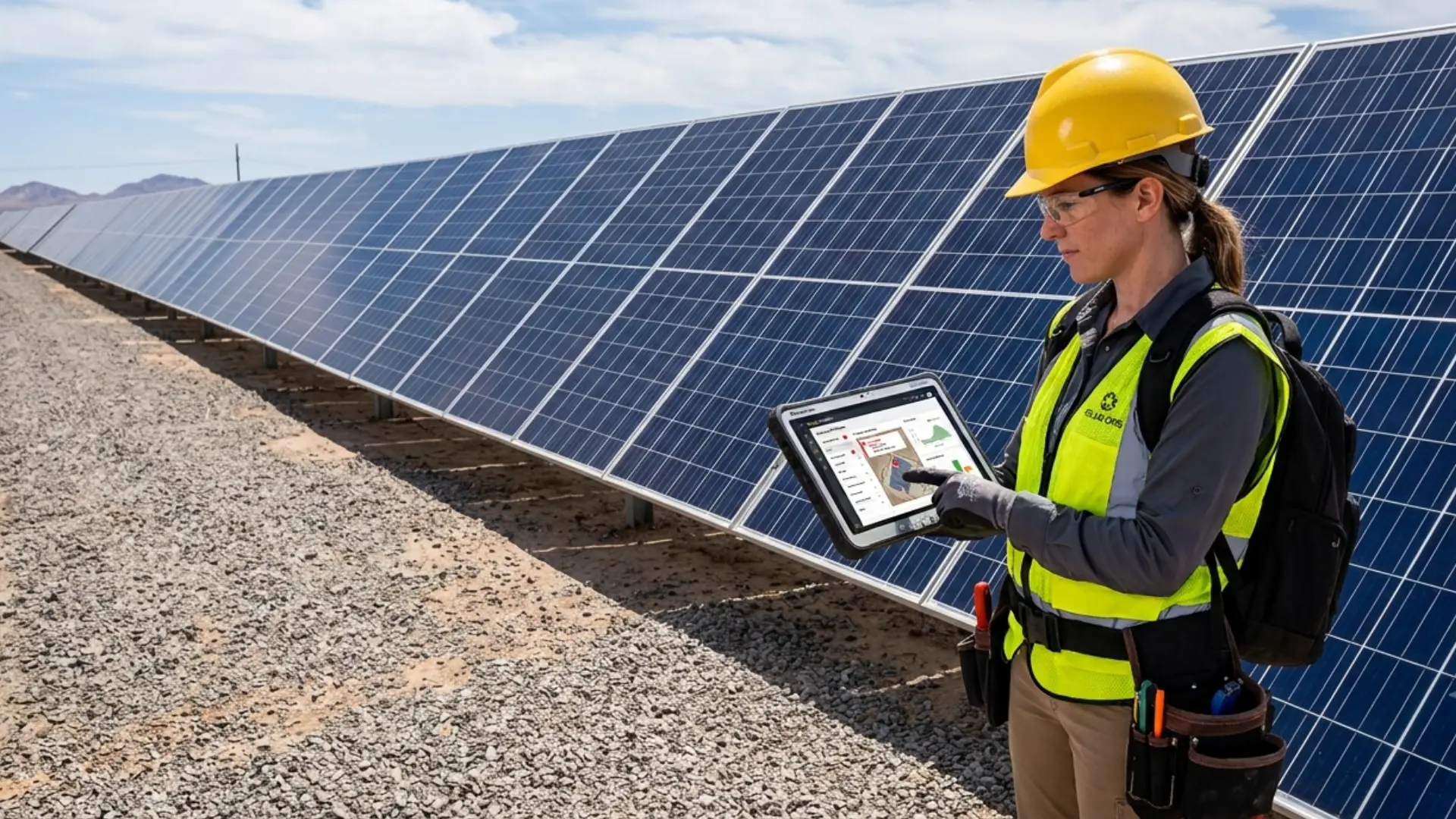
Power Apps provides the mobile and tablet interface that field technicians use on-site. In the solar context, the critical capability is offline operation: a site in a rural location with poor connectivity cannot depend on a cloud-connected form to capture corrective maintenance data during a fault response.
Power Apps model-driven applications operate with a local Dataverse cache that synchronises when connectivity is restored. Field technicians raise work orders, capture photo evidence, scan QR codes on inverter nameplates, complete safety checklists, and close out tasks — without a live internet connection. This is not a workaround; it is the designed operating model.
Power Apps also integrates natively with Microsoft Entra ID. There is no separate login, no additional credentials to manage, no new identity provider to add to the IT perimeter. A technician opens the Five Hundred mobile app with the same Microsoft account they use for Teams and Outlook.
Power Automate — Workflow and Escalation Logic
Power Automate is the workflow engine. The most operationally significant automation in solar O&M is the SCADA-to-work-order bridge: when a SCADA system raises an alarm — inverter communication fault, string underperformance, protection relay trip — Power Automate receives that alarm via webhook or API, classifies it against a rules engine, and automatically creates a prioritised work order in Five Hundred.
This eliminates the manual monitoring-to-maintenance handover that, in most solar operations teams, is the single largest source of response-time delay. The alarm fires at 07:14. The work order exists at 07:14. The technician receives a Teams notification at 07:14. The response clock starts immediately — not after a morning briefing.
Escalation rules, approval workflows, and SLA alerts are configured in Power Automate without custom code. A corrective task not closed within the defined SLA window triggers an escalation to the O&M Director. A critical fault on a site with an active PPA triggers a parallel alert to the asset owner. These are configuration choices, not development projects.
Dataverse — Enterprise-Grade Operational Data Store
Dataverse is the data layer — and the single most important architectural decision in the Five Hundred platform. Solar operators who have explored M365-adjacent CMMS approaches before have often built on SharePoint Lists. SharePoint Lists work for small deployments. At scale — twenty sites, ten years of operational records, a thirty-person technician fleet — they fail on performance, relational integrity, and governance.
Dataverse is a fully relational database with row-level security, audit logging, role-based access control, and native integration with the Power Platform. It supports the asset hierarchy solar O&M requires: Organisation → Portfolio → Site → Inverter Block → Inverter → String. Work orders, inspection records, spare parts transactions, and warranty claims are first-class entities in the Dataverse schema Five Hundred deploys with.
Critically, Dataverse environments are provisioned inside the client’s own Azure tenant. The data does not leave the client’s Microsoft 365 subscription. WIZSP deploys and configures the platform; the operational data belongs entirely to the operator. This makes EU data residency — and NIS2 compliance — a structural property of the deployment, not a contractual negotiation.
Power BI — Analytics Without a Third Platform
Solar operators who have invested in a SaaS CMMS frequently find themselves managing three platforms: SCADA for performance monitoring, CMMS for maintenance records, and a BI tool to bring the two data streams together for investor reporting.
Power BI is included in Microsoft 365 E3. Five Hundred ships with pre-built Power BI dashboards surfacing operational KPIs — MTTR, MTBF, corrective-to-preventive ratio, and Performance Ratio impact of outages — alongside investor-grade portfolio reporting. The data source is Dataverse. There is no additional pipeline, no API integration fee, no third vendor to manage.
The Case Against Yet Another SaaS Silo
Every new SaaS platform an organisation adopts adds the same overhead: a new SSO configuration, a new Data Processing Agreement, a new vendor security questionnaire, a new support queue, a new renewal negotiation, a new line in the business continuity plan.
For a solar operator managing grid-connected infrastructure across multiple EU member states, the compliance overhead of SaaS proliferation is material. NIS2 — in force for medium and large critical infrastructure operators since October 2024 — requires operators to assess and document the cybersecurity posture of their technology supply chain. Every SaaS vendor is part of that chain. Each one requires an assessment, a DPA review, and periodic re-evaluation.
Five Hundred runs inside the client’s existing Microsoft 365 tenant. There is no new vendor in the security supply chain. WIZSP’s role is that of an implementation partner — analogous to a Microsoft Solutions Partner deploying a Power Platform solution — not a data processor holding operational data on external infrastructure. The DPA is with Microsoft. The tenant is controlled by the client’s IT team. WIZSP’s access is governed by the client’s Entra ID policies.
We have no more access to your operational data than your own IT department decides to grant. For operators of critical energy infrastructure, this is not a feature. It is the only acceptable architecture.
Implementation Reality — What IT Teams Actually Experience
One legitimate concern about Microsoft 365-based platforms is implementation complexity. Power Platform projects at enterprise scale can balloon in scope. The Five Hundred implementation model is designed to prevent exactly that, with a bounded three-phase deployment.
- Tenant provisioning (Weeks 1–2): WIZSP provisions the Dataverse environment within the client’s existing M365 tenant. Entra ID groups are configured for role-based access — Technician, Supervisor, O&M Manager, Asset Owner, Read-Only Investor. Power Apps is deployed from the managed solution package. No new infrastructure is required — the client’s existing M365 subscription provides all compute, storage, and identity services.
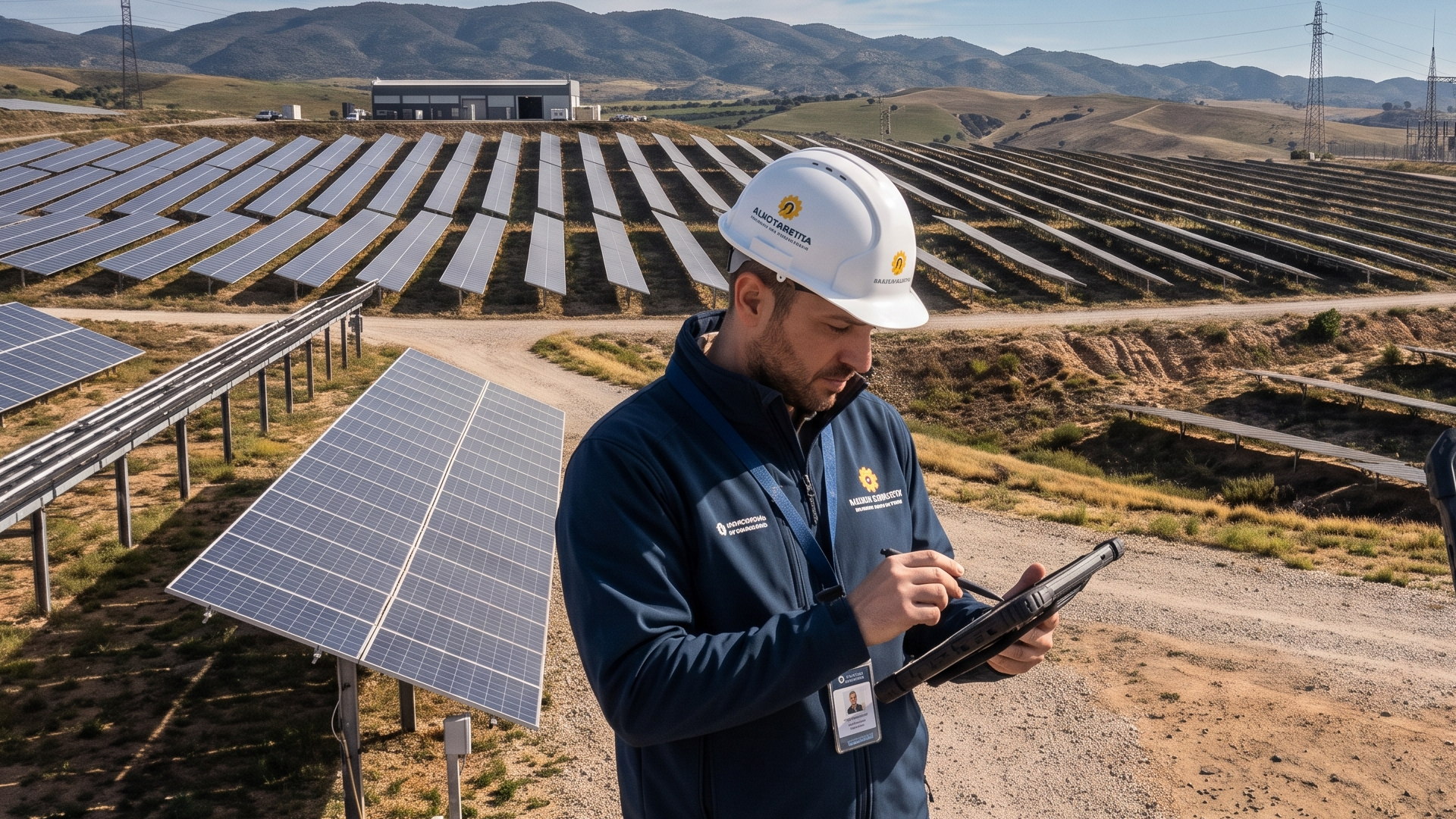
- Data migration and configuration (Weeks 2–5): Asset register import from the client’s existing spreadsheets or legacy CMMS, PM schedule configuration, site hierarchy setup, and SCADA integration. The SCADA integration is the variable that most affects timeline — the complexity depends on vendor and protocol. Five Hundred supports REST API, MQTT, and file-based alarm export. Brighter Green Engineering’s deployment across eleven sites completed in six weeks.
- Training and go-live (Weeks 6–8): Role-based training for field technicians (Power Apps mobile), supervisors (work order management and approval), and reporting users (Power BI). WIZSP provides on-site or remote training sessions and a full documentation library. Post-go-live hypercare support is included for thirty days.
The IT touchpoints are specific and bounded: Dataverse environment creation in the Microsoft 365 admin centre, Entra ID group configuration and licence assignment, and network allow-listing for Power Platform service endpoints. No server deployments, no firewall exceptions for external vendors, no ongoing infrastructure management responsibilities for the client’s IT team.
Frequently Asked Questions
Q1. What is a Microsoft 365 CMMS for solar?
A Microsoft 365 CMMS for solar is a computerised maintenance management system built natively on the Microsoft Power Platform — Power Apps, Power Automate, and Dataverse — that runs inside an organisation’s existing Microsoft 365 tenant. Unlike standalone SaaS CMMS platforms, it requires no separate vendor subscription or external data hosting. Five Hundred by WIZSP is the first CMMS purpose-built for solar O&M operations on this architecture.
Q2. How does a Microsoft 365-based CMMS differ from other CMMS platforms?
‘One-size-fits-all’ CMMS are SaaS platforms hosted on the vendor’s infrastructure, priced per user per month, and built for generic industrial maintenance. A Microsoft 365 CMMS like Five Hundred deploys inside the client’s own Azure tenant — the data never leaves the organisation — and is purpose-built for solar O&M workflows: SCADA alarm integration, Performance Ratio impact tracking, IEC 62446 documentation, and OEM warranty compliance. The commercial difference is the CAPEX model: one implementation fee, no recurring per-seat licence.
Q3. Can Five Hundred integrate with my SCADA system?
Yes. Five Hundred integrates with SCADA systems via REST API, MQTT, or file-based alarm export. Power Automate receives the alarm signal and automatically creates a prioritised work order, eliminating the manual monitoring-to-maintenance handover. The integration has been validated with Huawei FusionSolar, Sungrow iSolarCloud, and SMA Sunny Portal. Timeline and configuration scope depend on the SCADA vendor and communication protocol.
Q4. What Microsoft 365 licences are required to run Five Hundred?
Five Hundred requires at least Microsoft 365 E3 or equivalent, which includes Power Apps, Power Automate, Dataverse, and Power BI Pro. Most enterprise solar operators of 50 MW+ already hold M365 E3 as their standard office licence. If the organisation holds M365 E1 or Business Premium, a Power Apps per-user add-on provides the required capability. WIZSP provides a licence audit during scoping.
Q5. Is Five Hundred compliant with NIS2 and EU data residency requirements?
Yes. Because Five Hundred deploys inside the client’s own Microsoft 365 Azure tenant, all operational data is stored in the EU data residency region the client’s tenant is configured for. WIZSP does not hold or process operational data on its own infrastructure. The Data Processing Agreement is with Microsoft. This architecture satisfies NIS2 supply chain risk requirements and is consistent with standard lender and insurer data sovereignty clauses.
Conclusion
The solar CMMS market has a structural gap at precisely the intersection most European operators occupy: operationally mature, Microsoft 365-standardised, and increasingly constrained by NIS2 obligations and lender data sovereignty requirements. Generic SaaS platforms serve a different buyer profile. Enterprise EAM serves a different scale. Monitoring platforms serve a different function.
Five Hundred by WIZSP was built for the gap. Microsoft 365 is the right foundation for solar O&M — not because it happens to be available, but because it already meets the security, compliance, integration, and governance standards that critical infrastructure demands. The 500 seconds it takes for light to travel from the Sun to Earth is a constant. So is the logic of building operational software on infrastructure you own.
If your organisation manages 50 MW or more of solar assets on a Microsoft 365 estate, the Technical Architecture Brief below covers the full platform specification, Dataverse schema, and deployment model.