The dominant solar O&M architecture in most organisations is not a strategy — it is an accident. Teams typically arrive at their current setup by layering tools as problems emerged: a SCADA platform for monitoring, an Excel log for maintenance records, email-based work order assignment, and a shared drive holding compliance documents nobody can locate quickly. The result is what enterprise architects call distributed operational debt — data scattered across systems that do not communicate, workflows dependent on human memory, and reporting that requires days of manual assembly.
This is not a tooling problem. It is an architecture problem. And it has a measurable cost in every direction: response time, compliance readiness, reporting accuracy, and total software expenditure over a five-year horizon.
This article defines what a coherent solar O&M architecture looks like, identifies the five signals that your current setup is working against operational performance, and explains why a Microsoft 365-native approach eliminates the architectural debt that fragmented SaaS stacks accumulate with every passing quarter.
What “Solar O&M Architecture” Actually Means
Solar O&M architecture is the structural design of the systems, data flows, and operational workflows that manage the lifecycle of a photovoltaic asset — from SCADA alarm to closed work order, from field inspection record to investor performance report.
A coherent architecture operates across three interdependent layers:
The data layer — where operational data lives, how it is structured, who owns it, and how it is protected. A coherent data layer is a single source of truth, not a collection of disconnected system exports merged manually in a spreadsheet at the end of every reporting cycle.
The workflow layer — how tasks move from trigger to completion without manual handoffs. In a correct architecture, a SCADA alarm creates a structured work order, assigns it to the right technician, updates the asset record on completion, and closes the loop automatically. No email required. No human relay between systems.
The reporting layer — how field data becomes financial intelligence. In a correct architecture, a Finance Director or investment committee accesses portfolio performance data directly, without waiting for an analyst to extract, format, and validate it from three separate sources.
When all three layers operate within a single platform and a unified data model, the result is operational continuity — every alarm, every work order, every technician note, every compliance checkpoint existing in one searchable, auditable environment. When they operate across disconnected tools, the opposite occurs — and the costs compound silently until a compliance audit, a reporting deadline, or an investor question makes them impossible to ignore.
Five Signs Your Solar O&M Architecture Is Working Against You
1. Work Orders Are Assigned by Email
Your SCADA system detects an inverter fault. An alert is read by someone. An email is sent to someone else. A technician eventually receives an assignment — perhaps the same day, perhaps three days later, depending on who was monitoring which inbox. This is not a workflow. It is a dependency chain with no audit trail, no SLA enforcement, no escalation logic, and no automated closure. When a regulator or an investor requests the incident response record, the answer is buried in an email thread with no timestamp on the field resolution.
2. Field Records Live in Spreadsheets
Technicians complete inspections and record findings in Excel or on paper forms that are later — sometimes — transferred to a central spreadsheet. By the time the data is aggregated, it is already stale, stripped of operational context, and disconnected from the SCADA event that triggered the original task. Compliance documentation produced from this foundation carries inherent uncertainty. Auditors experienced with photovoltaic operations recognise this immediately.
3. Investor Reporting Takes Days of Manual Effort
If quarterly portfolio reporting requires your Finance Director to wait while analysts manually extract data from SCADA exports, maintenance logs, and email archives — you are experiencing a reporting architecture failure. The data exists, but it is not structured, not accessible in real time, and not production-ready without hours of preparation. This delay is not a staffing problem. It is a design problem that recurs every quarter at the same cost.
4. Compliance Audits Require Reconstruction Work
The IEC 62446 standard for photovoltaic systems requires systematic documentation of commissioning, inspection, and maintenance records throughout the operational life of a solar installation. When those records exist across disconnected systems — some digital, some paper-based, some in files belonging to staff who have since left the organisation — audit preparation becomes an exercise in reconstruction rather than retrieval. For EU energy operators operating under the obligations of the NIS2 Directive, which imposes cybersecurity requirements on operators of essential services including energy infrastructure, this is not a minor administrative inconvenience. It is a compliance liability with consequences.
5. Software Costs Scale with Every New Hire
Per-user SaaS licensing means that every technician added to the field team increases monthly software expenditure proportionally. This cost is invisible at ten users. At fifty users across a multi-site portfolio, it becomes a material operational budget line that compounds indefinitely — with no capital asset accumulating on the balance sheet and no equity built in the infrastructure your team depends on every day.
Why Most Solar Software Platforms Make the Problem Worse
The market response to the solar O&M architecture problem has been to offer more point solutions. A dedicated work order module here. A compliance checklist application there. A standalone reporting platform that requires integration with both. Each new tool addresses one symptom while creating two new problems: a data synchronisation problem and an integration maintenance obligation that belongs to the operator, not the vendor.
Per-user SaaS pricing compounds this pattern structurally. Every new platform represents a new contract, a new vendor relationship, and a new data silo. When a vendor is acquired, discontinues a product line, or restructures its pricing — all of which are recurring events in the enterprise software industry — the O&M team faces a migration project at significant operational and financial cost, with no input into the timeline and no leverage in the negotiation.
The deeper structural issue is data sovereignty. Most commercial SaaS platforms host operational data on infrastructure the operator does not own or control. For European solar operators, this creates measurable exposure under the NIS2 Directive, which specifically addresses cybersecurity obligations for operators of essential services in the energy sector. Storing grid-connected asset health data, production records, and workforce safety logs in a vendor-controlled environment is an architecture decision with regulatory consequences that are increasingly enforced rather than merely noted.
The Microsoft 365-Native Solar O&M Architecture: A Different Design Philosophy
Five Hundred deploys natively inside the client’s own Microsoft 365 tenant. This is not a SaaS application with a Microsoft login option. It is not a cloud integration or an API connector layered on top of a vendor-hosted database. The platform provisions directly within the operator’s Azure environment — using Microsoft Dataverse as the unified data layer, Power Apps as the field operations interface, Power Automate as the workflow engine, and Power BI as the analytics and investor reporting layer.
The architectural consequences of this design decision are significant and compound over time.
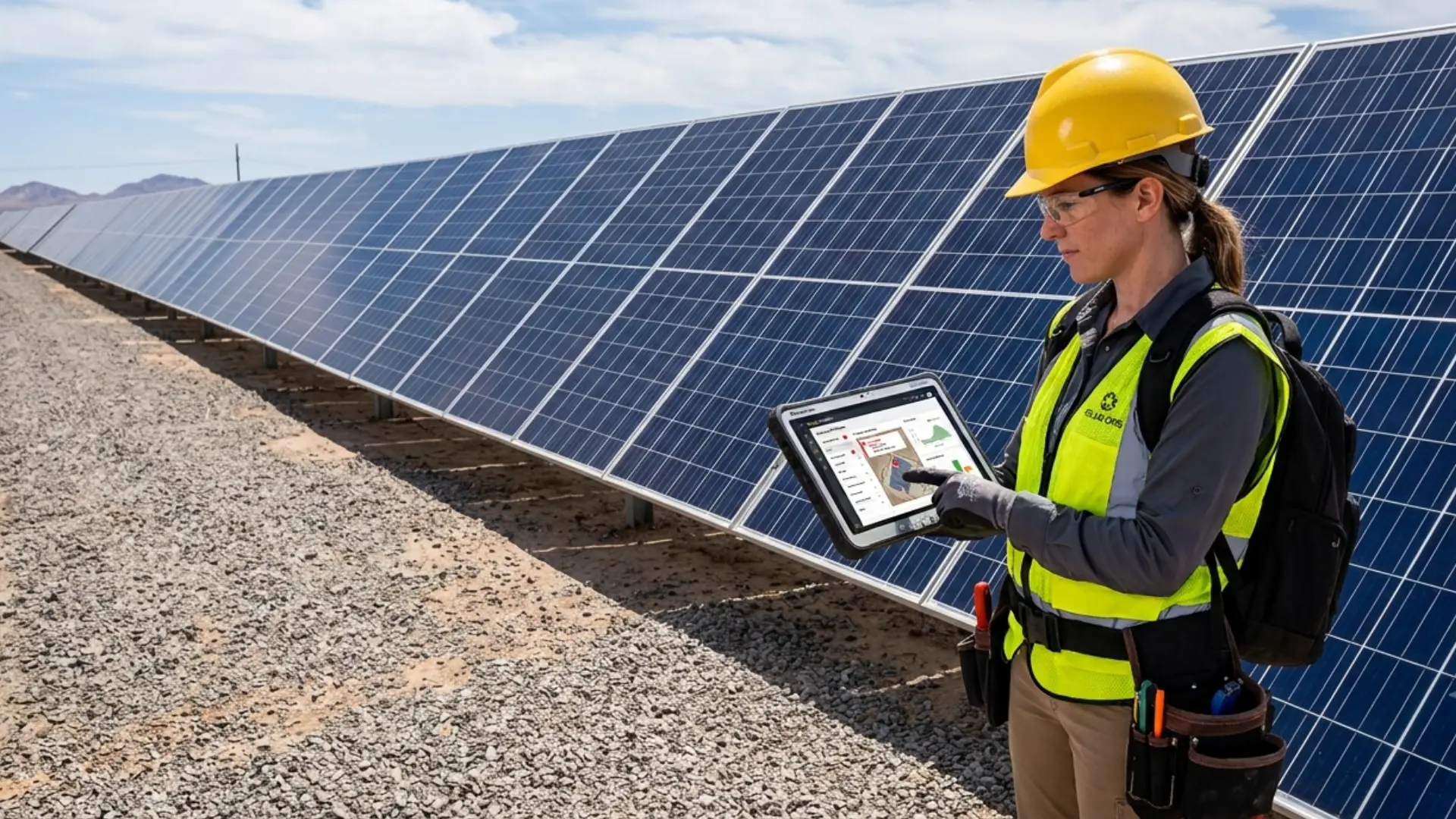
A single data model, zero integration debt. All operational data — assets, work orders, preventive maintenance schedules, SCADA alarm history, spare parts inventory, compliance records, and inspection results — exists in one Dataverse environment. There are no API calls synchronising records between systems. There is no risk of data divergence. The asset record visible in Power Apps on a technician’s tablet is the same record populating the investor Power BI dashboard in real time.
SCADA alarm to work order in under 60 seconds. When a SCADA system issues an HTTP POST or webhook on fault detection, Power Automate receives the event, creates a structured work order in Dataverse, assigns it based on technician availability and site proximity, and dispatches a field notification — all without human intervention. This workflow eliminates the alarm gap: the interval between fault detection and field response that remains unmeasured and unmanaged in email-driven architectures. For a detailed technical breakdown of this integration pattern, see: How SCADA Alarms Become Work Orders in Microsoft 365 →
No per-user licensing growth. Five Hundred is deployed under a one-time CAPEX model. The Microsoft 365 licences the team already holds provide the access layer. Whether the portfolio grows from five sites to fifty, and whether the field team grows from ten technicians to one hundred, the software cost does not scale. This is the structural difference between a capital asset and a perpetual rental — a difference that compounds significantly over a five-year horizon in the Finance Director’s favour.
EU data sovereignty by architecture, not by policy statement. Because Five Hundred deploys within the operator’s own Azure tenant, operational data never leaves the organisation’s control. The GDPR compliance boundary is the operator’s own infrastructure. The NIS2 attack surface attributable to the software layer is structurally eliminated — because no software vendor holds the data.
For a complete overview of operational modules available within this architecture, see: Five Hundred Solar O&M Software Modules →
What a Correct Architecture Looks Like in Practice
Brighter Green Engineering (BGE) deployed Five Hundred across their solar portfolio with a six-week go-live timeline. Prior to deployment, quarterly portfolio performance reporting required four days of manual data extraction, spreadsheet assembly, and validation per reporting cycle — a significant operational overhead with a corresponding accuracy risk at every stage of the process.
After deployment, the same report was produced in under three hours, drawn directly from the Power BI reporting layer connected to live Dataverse records. No manual extraction. No spreadsheet assembly. No delay between what is happening in the field and what the investment committee sees in the boardroom.
The architecture that enabled this result was not complex. It was coherent: one data model, one workflow engine, one reporting layer — all operating inside BGE’s existing Microsoft 365 tenant, on infrastructure they already owned, with data that never left their control.
Read the full Brighter Green Engineering case study →
Architecture Decisions Have a Five-Year Operational Horizon
The choice of O&M software architecture is not a quarterly subscription decision. It is a capital allocation decision with a five-year or longer operational horizon. The wrong architecture accumulates costs that are invisible in year one but material by year three: integration maintenance overhead, per-user licence growth as the team scales, migration costs when vendors change terms or exit the market, and compliance exposure from operational records that are unstructured and difficult to retrieve.
A financial model comparing CAPEX deployment against equivalent SaaS alternatives consistently demonstrates breakeven within 18 months, with compounding savings thereafter. The exact figures depend on portfolio size, current tool expenditure, and reporting overhead — variables that the Five Hundred TCO model is designed to quantify precisely for each deployment scenario.
Run the five-year solar CMMS total cost of ownership model →
Architecture also determines what is operationally possible as portfolios scale. A platform built natively on Microsoft 365 can extend into adjacent operational domains — EHS management, contractor supervision, investor portals, procurement workflows — using the same data model, the same security boundary, and the same Microsoft licences already in place. A collection of disconnected SaaS tools cannot extend in any direction without adding another vendor, another integration dependency, and another recurring cost.
Frequently Asked Questions About Solar O&M Architecture
What is solar O&M architecture?
Solar O&M architecture is the structural design of the software systems, data models, and operational workflows used to manage the maintenance, compliance, and performance reporting of a photovoltaic portfolio. A coherent architecture ensures that operational data flows from field activity to financial reporting without manual intervention, duplication, or loss of context at any stage of the process.
Why does platform architecture matter for solar operations management?
Architecture determines whether an O&M system scales with a portfolio or against it. A fragmented architecture — multiple disconnected tools with separate data stores — creates compounding maintenance overhead, compliance risk from unstructured records, and reporting delays that affect investor confidence and regulatory standing. A coherent architecture eliminates these costs by structural design rather than by operational workaround.
How does a Microsoft 365-native platform improve solar O&M architecture?
Microsoft 365 provides an enterprise-grade infrastructure — Dataverse, Power Apps, Power Automate, Power BI, and Azure Active Directory — that covers every operational layer within a single, unified platform. Deploying inside the operator’s own tenant means that EU data sovereignty is achieved by architectural design, all operational data uses a single model, and the workflow layer connects directly to SCADA events without third-party integration middleware.
What are the warning signs of poor solar O&M software architecture?
The clearest signals are: work orders assigned by email rather than automated from SCADA events; field inspection records stored in spreadsheets disconnected from the asset database; investor reporting that requires days of manual data extraction; compliance documentation that cannot be retrieved quickly for audit; and per-user SaaS licensing costs that grow in direct proportion to team size with no capital asset accumulating on the balance sheet.
Is a Microsoft 365-native solar CMMS suitable for large portfolios?
Yes. Microsoft Azure and Dataverse infrastructure underpins enterprise operations at global scale across every major industry. For solar O&M, the relevant scaling dimensions are asset count, work order volume, site count, and concurrent user load — all of which Dataverse handles natively at any portfolio size, without architectural changes or licence tier upgrades.
The Architecture Choice Is the Strategy
The solar O&M architecture your organisation runs on is one of the most consequential operational decisions an O&M Director or CTO will make — not because it is technically complex, but because its effects compound invisibly over years. A coherent architecture reduces MTTR, eliminates compliance gaps, produces real-time financial intelligence, and keeps operational data inside the infrastructure the operator controls. A fragmented one does the opposite, at compounding cost, until the accumulation becomes impossible to ignore.
Getting the architecture right does not require rebuilding from scratch. It requires deploying a platform designed specifically for the job — built natively on the infrastructure your organisation already owns, licensed for the Microsoft 365 seats already paid for, and operated within a data boundary your team controls entirely.
To understand how Five Hundred’s Microsoft 365-native architecture applies to your portfolio, schedule a technical discovery call.